 Yuuna
Practice Spanish by talking with an AI tutor
Yuuna is an AI tutor you chat with in Spanish. It answers at your level, corrects your mistakes with a short reason in your own language, and adds the meaning of each line, so you can keep a conversation going from your first weeks.
Start practicingSign in with Google. Your first 30 messages are free.
What a Spanish chat looks like
Yuuna
¡Hola!
Hi!
Soy Yuuna.
I'm Yuuna.
Hoy he desayunado tarde, como siempre.
Today I had breakfast late, like always.
No soy nada de mañanas: me despierto muy despacio.
I'm not a morning person at all: I wake up very slowly.
Ahora estoy en casa con un café. ¿Y tú, cómo empiezas el día?
Right now I'm at home with a coffee. And you, how do you start the day?
TipIn Spain, "no soy nada de mañanas" is a natural way to say you're not a morning person. You can also say "no soy mañanero" (if you're male) or "mañanera" (if you're female).
CultureIn Spain, breakfast is usually small: coffee with milk and maybe a piece of toast or a pastry, often at a bar before work. Lunch is the big meal, around 2 p.m.
Learner
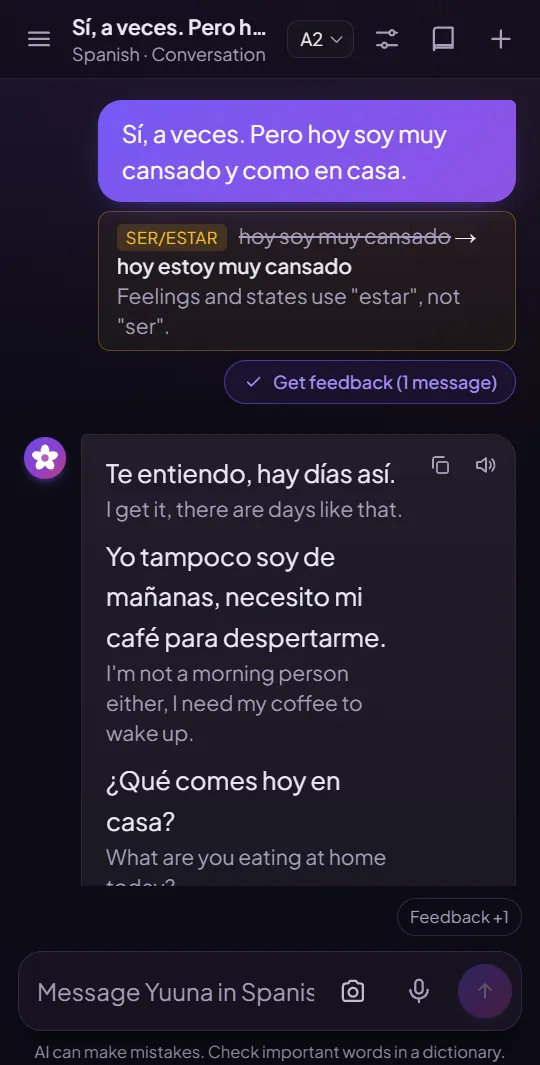
Me levanto a las siete, pero por la mañana soy muy cansado.
Correction · Ser/estar
por la mañana soy muy cansado → por la mañana estoy muy cansado
Feelings and states use "estar", not "ser".
Yuuna
Te entiendo. Yo a las siete todavía estoy dormida.
I get you. At seven I'm still asleep.
Estoy cansada hasta las diez, más o menos.
I'm tired until about ten.
¿A qué hora te acuestas normalmente?
What time do you usually go to bed?
TipRemember: "ser" for what someone is like (soy cansado = I'm a tired person, always), "estar" for how they feel right now (estoy cansado = I'm tired today).
Suggested replies
Me acuesto a las once.
I go to bed at eleven.
Siempre estoy cansado por la mañana.
I'm always tired in the morning.
Necesito más café.
I need more coffee.
Spain or Mexico, with the meaning under every line
Spanish is written the way it sounds, so there is no reading line. Under each line the tutor writes is its meaning in your own language. Tap any word for a quick explanation, with links to Wiktionary and WordReference and a button to save it for review.
The tutor says tú unless the scene calls for usted.
Now and then a reply ends with a tip on usage or a culture note, like the ones in the exchange above.
You can speak your answer instead of typing it, and listen to any reply.
When you start a chat you choose the Spanish of Spain (es-ES), with vosotros, or of Mexico (es-MX), with ustedes and Latin American usage. There is no setting for other countries.
What the tutor corrects in Spanish
When you make a mistake, a card shows what you wrote, the fix, and one short reason. In Spanish chats these are the usual ones:
- Gender
- el or la, un or una: el problema, la mano.
- Agreement
- articles and adjectives that must match the noun: las casas blancas.
- Ser and estar
- the two verbs for "to be": soy alto, but estoy cansado.
- Verb tense
- the two past tenses (fui, iba) and the irregular forms.
- Subjunctive
- after quiero que, espero que or cuando: quiero que vengas.
- Prepositions
- por or para, and a, en and de.
- Word choice
- a word that exists but does not fit what you meant.
- Spelling and accents
- missing accents and ñ: está, qué, mañana.
Levels: from zero to C2
You pick a level and the tutor keeps its Spanish there, on the European scale from A1 to C2:
| Level in Yuuna |
|---|
| New to it (no Spanish yet) |
| A1 · beginner |
| A2 · elementary |
| B1 · intermediate |
| B2 · upper intermediate |
| C1 · advanced |
| C2 · mastery |
The levels describe how hard the Spanish is. They are not an exam score, and Yuuna is not a DELE course. Not sure where you are? A short chat of about five questions finds your level.
Starting Spanish from zero
Choose "New to it" and the tutor explains everything in your own language. The starter course is 9 short lessons of 10 to 15 minutes; each one is a chat in which the tutor teaches a few things and you try them. The first two are on how Spanish sounds and is spelled; then come listening and speaking, the first grammar and how to recognize Spanish by sight and by ear, and only then the first expressions:
- 1.Sounds and spelling: how Spanish sounds and is spelled: the five vowels and the accent mark on the stressed syllable (café), then h, j and soft g, soft c and z, qu, ll and y, ñ, r and rr, b and v said alike, and ¿ ¡.
- 2.Sounds: pronunciation practice: practice of how Spanish sounds and is spelled, no new rules: short words read aloud and matched both ways, sounds that are easy to mix up side by side, where the stress falls, and the ones the learner found hard.
- 3.Listening and speaking: Hearing Spanish words played and telling close ones apart (pero, perro), writing short words heard, and saying words aloud with the microphone: r and rr, j, the five vowels.
- 4.Grammar: how a sentence works: How a Spanish sentence works: the word order, soy, eres and es (am, are, is), no before the verb for not, and a yes or no question by rising voice between ¿ and ?.
- 5.Grammar: small words and endings: The first building blocks: el and la, un and una, masculine and feminine nouns (libro, casa), plurals with s and los, las, and the verb ending that says who (hablo, hablas, habla).
- 6.Recognizing it by sight and by ear: Recognizing Spanish by sight and by ear: ¿ ¡ ñ and -ción, the steady beat of five clear vowels, how it differs from Portuguese and Italian, words already known, and where it is spoken.
- 7.Hello, thank you, goodbye
- 8.Saying who you are
- 9.Your first conversation
Things to try in Spanish
Past the first lessons you choose what each chat is for: a free conversation, a role-play in which the tutor plays the other person, a short lesson, a text to read at your level, or your own writing corrected. A few of the ideas the app offers:
- Ordering at a café
- Planning a trip
- Past tense
- Articles and gender
- Idioms
What Yuuna does not do
- It does not score your pronunciation. You can speak instead of typing and listen to a reply, but nothing grades how you sound.
- It is not a DELE or SIELE course: there are no mock exams and no scores.
- There is no human teacher. Every reply comes from an AI model and can be wrong.
Sign in with Google. Your first 30 messages are free.
Everything Yuuna does · All languages: Chinese · Japanese · English · Korean · French · German · Italian · Portuguese · Russian · Arabic