 Yuuna
Practice Korean by talking with an AI tutor
Yuuna is an AI tutor you chat with in Korean. It answers at your level, corrects your mistakes with a short reason in your own language, and shows how each line is said, so you can start while you are still learning Hangul.
Start practicingSign in with Google. Your first 30 messages are free.
What a Korean chat looks like
Yuuna
annyeonghaseyo!
안녕하세요!
Hi!
oneul jageun kapeeseo chareul masyeosseoyo.
오늘 작은 카페에서 차를 마셨어요.
I drank tea at a small café today.
joyonghaeseo cham joasseoyo.
조용해서 참 좋았어요.
It was really nice and quiet.
yojeum bame ingneun chaegeun jaemiisseoyo?
요즘 밤에 읽는 책은 재미있어요?
Is the book you’re reading at night interesting these days?
Learner
네, 아주 재미있어요. 주말에 도서관에 책을 읽어요.
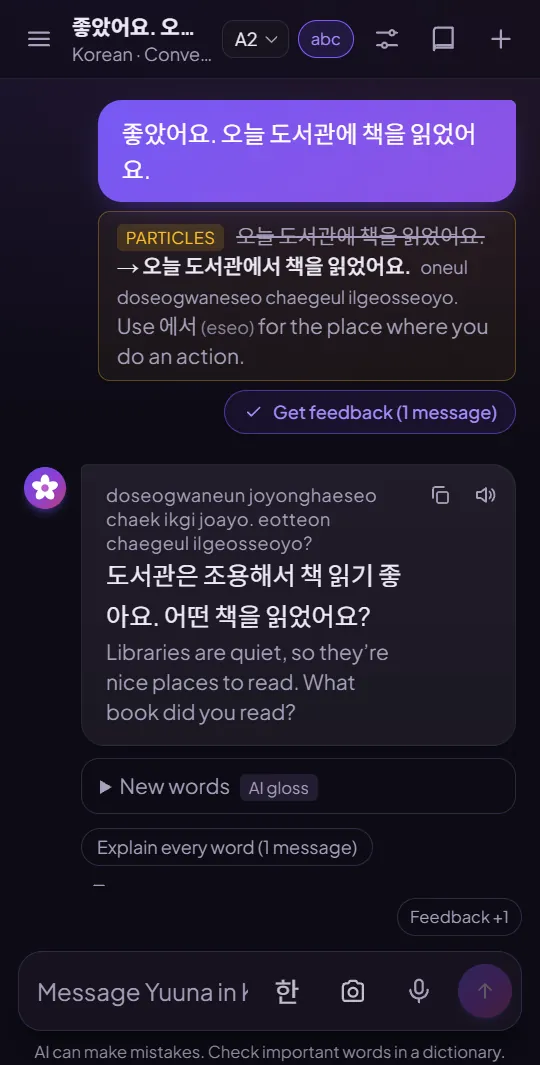
Correction · Particles
주말에 도서관에 책을 읽어요. → 주말에 도서관에서 책을 읽어요.
jumare doseogwaneseo chaegeul ilgeoyo.
Use 에서 (eseo) for the place where you do an action.
Yuuna
doseogwaneun joyonghaeseo chaek ikgi joayo. jeodo joyonghan goseseo chaek ingneun geol joahaeyo.
도서관은 조용해서 책 읽기 좋아요. 저도 조용한 곳에서 책 읽는 걸 좋아해요.
Libraries are quiet, so they’re nice places to read. I also like reading in quiet places.
Suggested replies
jumare soseoreul ilgeoyo.
주말에 소설을 읽어요.
I read novels on the weekend.
doseogwaneseo gongbudo haeyo.
도서관에서 공부도 해요.
I study at the library, too.
gakkeum jibeseo chaegeul ilgeoyo.
가끔 집에서 책을 읽어요.
I sometimes read at home.
Reading Korean: Hangul with a romanization
Above each line the tutor writes, you see the same line in Latin letters. The romanization follows how the words are said, sound changes included: 읽는 is shown as "ingneun", not letter by letter. One switch in the chat header or in Settings hides it once you read Hangul.
The romanization is made by the app itself, not written by the AI model.
Under each line is its meaning in your own language. Tap any word for a quick explanation, with links to Wiktionary and the Naver dictionary and a button to save it for review.
Cannot type Hangul yet? Write Korean in Latin letters, like "jeoneun chaegeul ilgeoyo". The tutor reads it as Korean, writes your line back in Hangul and corrects only real grammar or word mistakes, never the letters.
What the tutor corrects in Korean
When you make a mistake, a card shows your line, the fixed line with its romanization, and one short reason. In Korean chats these are the usual ones:
- Particles
- 은/는 or 이/가, 을/를, 에 or 에서: the endings that say who does what, where and to what.
- Speech level
- mixing polite 해요 forms with casual or formal ones in the same conversation.
- Verb endings
- tense and connecting endings, such as 었어요, 고 and 아서.
- Word choice
- a word that exists but does not fit what you meant.
- Spacing
- where words are written apart and where they are joined.
- Honorifics
- the forms for speaking about someone you respect, such as 계세요 and 드세요.
- Word order
- the verb at the end, with the time and the place before it.
- Counters
- the counting words after numbers, such as 개, 명 and 권.
The tutor speaks polite Korean (해요 forms) unless the scene is a casual one between friends. You can also set the tone of each chat yourself.
Levels: from zero to TOPIK 6
You pick a level and the tutor keeps its Korean there. Yuuna uses the European A1 to C2 scale and shows the nearest TOPIK level next to it:
| Level in Yuuna | About the same as |
|---|---|
| New to it (no Korean yet) | before the first level |
| A1 · beginner | TOPIK 1 |
| A2 · elementary | TOPIK 2 |
| B1 · intermediate | TOPIK 3 |
| B2 · upper intermediate | TOPIK 4 |
| C1 · advanced | TOPIK 5 |
| C2 · mastery | TOPIK 6 |
The TOPIK names are a rough guide to how hard the Korean is. They are not an exam score, and Yuuna is not a TOPIK course. Not sure where you are? A short chat of about five questions finds your level.
Starting Korean from zero
Choose "New to it" and the tutor explains everything in your own language and starts with Hangul. The starter course is 11 short lessons of 10 to 20 minutes; each one is a chat in which the tutor teaches a few things and you try them. The first four are on the writing; then come listening and speaking, the first grammar and how to recognize Korean by sight and by ear, and only then the first expressions:
- 1.The writing: first letters: how Hangul works: the basic vowels ㅏ ㅓ ㅗ ㅜ ㅡ ㅣ and consonants ㄱ ㄴ ㄷ ㄹ ㅁ ㅇ (silent before a vowel), and how they stack into a syllable block (가, 나, 무).
- 2.The writing: more letters: the other consonants (ㅂ ㅅ ㅇ ㅈ ㅎ, then ㅋ ㅌ ㅍ ㅊ) and the y-vowels (ㅑ ㅕ ㅛ ㅠ) and combined vowels (ㅐ ㅔ, ㅘ ㅝ ㅚ ㅟ ㅢ, then ㅒ ㅖ ㅙ ㅞ), each with one common word.
- 3.The writing: reading words: final consonants (받침), double consonants, and reading whole words aloud: a final consonant moves on to a following ㅇ (음악 sounds 으막), and ㅂ before ㄴ sounds ㅁ (합니다 sounds 함니다).
- 4.The writing: reading practice: reading practice with all the letters, no new ones: short words read aloud and matched both ways, look-alike letters side by side (ㅓ ㅗ, ㅐ ㅔ, ㄱ ㅋ ㄲ), and the ones the learner found hard.
- 5.Listening and speaking: hearing Korean and saying it: plain, breathy and tense consonants (불 풀 뿔), ㅓ or ㅗ, ㅡ or ㅜ, final consonants, and saying words aloud with the microphone.
- 6.Grammar: how a sentence works: how a Korean sentence works: the verb comes last, X is Y with 이에요 or 예요, not with 아니에요, a yes/no question by raising the voice, and 네 and 아니요.
- 7.Grammar: small words and endings: the first small words and endings: 는 for what you talk about and 를 for the thing acted on, each with its form after a consonant (은, 을), and the polite verb ending 요 (가요, 먹어요, 마셔요).
- 8.Recognizing it by sight and by ear: recognizing Korean: Hangul blocks with circles, spaces between words, consonant endings, sentences ending in yo or nida, telling it from Japanese and Chinese, known words, where it is spoken.
- 9.Hello, thank you, goodbye
- 10.Saying who you are
- 11.Your first conversation
Things to try in Korean
Past the first lessons you choose what each chat is for: a free conversation, a role-play in which the tutor plays the other person, a short lesson, a text to read at your level, or your own writing corrected. A few of the ideas the app offers:
- Ordering at a café
- Meeting a new neighbour
- Polite requests
- Verb endings
- My weekend
What Yuuna does not do
- It does not score your pronunciation. You can speak instead of typing and listen to a reply, but nothing grades how you sound.
- It is not a TOPIK course: there are no mock exams and no scores.
- It can miss a mistake. In a first try for this page a wrong particle (차가 좋아해요) went uncorrected; the exchange above is from the second chat.
- There is no human teacher. Every reply comes from an AI model and can be wrong.
Sign in with Google. Your first 30 messages are free.
Everything Yuuna does · All languages: Chinese · Japanese · Spanish · English · French · German · Italian · Portuguese · Russian · Arabic