 Yuuna
Practice Chinese by talking with an AI tutor
Yuuna is an AI tutor you chat with in Mandarin Chinese. It answers at your level, corrects your mistakes with a short reason in your own language, and puts pinyin above the characters, so you can read along from the first day.
Start practicingSign in with Google. Your first 30 messages are free.
What a Chinese chat looks like
Yuuna
nǐ hǎo! wǎn shàng wǒ xǐ huan màn màn hē yì bēi rè chá.
你好!晚上我喜欢慢慢喝一杯热茶。
Hi! In the evening, I like to slowly drink a cup of hot tea.
nǐ wǎn shàng xǐ huan zuò shén me?
你晚上喜欢做什么?
What do you like to do in the evening?
Learner
我喜欢看书。昨天我买了三个书。
Correction · Measure words
三个书 → 三本书
sān běn shū
Use 本 (běn) as the measure word for books.
Yuuna
wǒ yě xǐ huan kàn shū, shuì jiào qián kàn yí huì er hěn fàng sōng. nǐ zuó tiān mǎi le shén me shū?
我也喜欢看书,睡觉前看一会儿很放松。你昨天买了什么书?
I also like reading. Reading for a while before bed is relaxing. What books did you buy yesterday?
Suggested replies
wǒ mǎi le yì běn xiǎo shuō
我买了一本小说。
I bought a novel.
wǒ mǎi le sān běn gù shì shū
我买了三本故事书。
I bought three storybooks.
wǒ mǎi de shì zhōng wén shū
我买的是中文书。
I bought Chinese books.
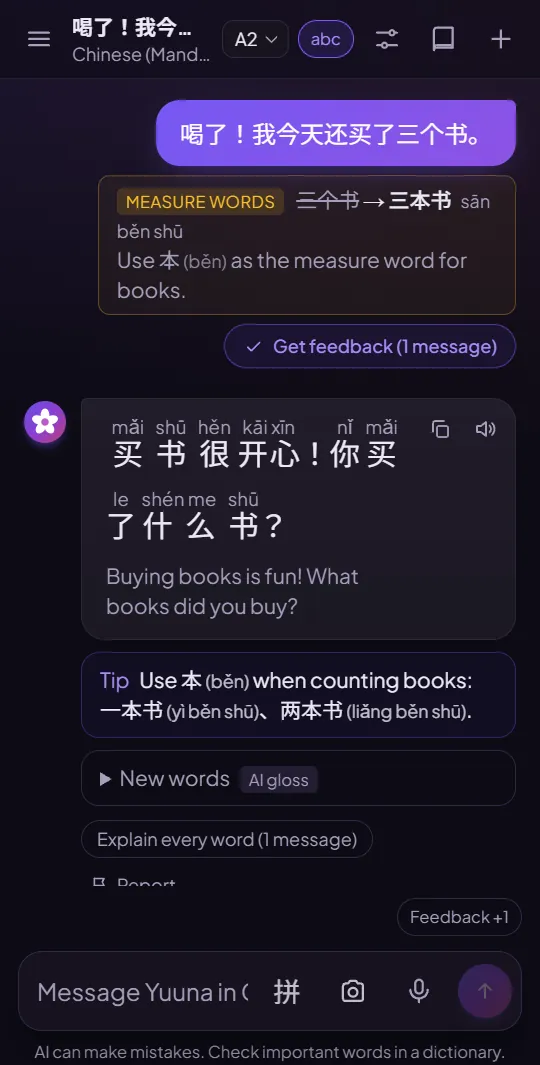
Reading Chinese: pinyin above the characters
Every line the tutor writes has pinyin with tone marks above the characters, word by word (in the exchange above it is set on its own line). One switch in the chat header or in Settings hides it when you want to test yourself.
The pinyin is made by the app itself, not written by the AI model. A character with more than one reading can still get the wrong one now and then.
Under each line is its meaning in your own language. Tap any word for a quick explanation, with links to Wiktionary and Jade Dictionary and a button to save it for review.
Cannot type characters yet? Write pinyin without tone marks, like "wo xihuan kan shu". The tutor reads it as Chinese, writes your line back in characters and corrects only real grammar or word mistakes, never the missing tones.
When you start a chat you choose Simplified characters with mainland usage (zh-CN) or Traditional characters (zh-TW). Yuuna teaches Mandarin, not Cantonese.
What the tutor corrects in Chinese
When you make a mistake, a card shows what you wrote, the fix with its pinyin, and one short reason. In Chinese chats these are the usual ones:
- Word order
- where the time, the place and the verb go: 我明天去, not 我去明天.
- Measure words
- the word between a number and a noun: 三本书, 一杯茶, 两个人.
- Particles
- the small words at the end of a sentence, such as 吗, 呢 and 吧.
- Aspect
- 了, 过 and 着: whether something is done, has ever happened or is going on.
- Word choice
- a word that exists but does not fit what you meant.
- Tones
- a wrong tone mark in pinyin you typed. Leaving tone marks out is never counted as a mistake.
Levels: from zero to HSK 7-9
You pick a level and the tutor keeps its Chinese there. Yuuna uses the European A1 to C2 scale and shows the nearest HSK level next to it:
| Level in Yuuna | About the same as |
|---|---|
| New to it (no Chinese yet) | before the first level |
| A1 · beginner | HSK 1-2 |
| A2 · elementary | HSK 3 |
| B1 · intermediate | HSK 4 |
| B2 · upper intermediate | HSK 5 |
| C1 · advanced | HSK 6 |
| C2 · mastery | HSK 7-9 |
The HSK names are a rough guide to how hard the Chinese is. They are not an exam score, and Yuuna is not an HSK course. Not sure where you are? A short chat of about five questions finds your level.
Starting Chinese from zero
Choose "New to it" and the tutor explains everything in your own language and starts with the sounds. The starter course is 11 short lessons of 10 to 20 minutes; each one is a chat in which the tutor teaches a few things and you try them. The first four are on the tones and the first characters; then come listening and speaking, the first grammar and how to recognize Chinese by sight and by ear, and only then the first expressions:
- 1.The writing: first letters: how Mandarin sounds: the four tones, shown on 妈 麻 马 骂 (the characters only carry the sound), then pinyin, the spelling under each line: j q x z c zh ü e, each on one tiny word.
- 2.The writing: more letters: the first characters: 一 二 三 人 口 日 我 你 好, what a character is, how strokes go (top to bottom, left to right), parts that hint at meaning (亻 in 你 is 人), and reading 你好 and 我.
- 3.The writing: reading words: tone pairs and the neutral tone, then ten everyday characters and words (是 不 很 吗 谢谢), read aloud, with the two tone changes: 你 rising in 你好 and 不 rising before a fourth tone (不是).
- 4.The writing: reading practice: practice, no new characters: the tones and the characters so far in short words, read aloud and matched both ways, and the ones the learner found hard.
- 5.Listening and speaking: hearing Mandarin and saying it: telling the four tones apart, b or p, s or sh, u or ü, and saying words aloud with the microphone so the right character comes out.
- 6.Grammar: how a sentence works: how a Chinese sentence works: the order who, verb, what, X 是 Y (I am a student), 不 before a verb for not, 吗 at the end for a yes/no question, and 很 before a describing word (我很好).
- 7.Grammar: small words and endings: the first small words: words never change (no endings for person, time or plural), 他 he and 她 she sound the same, 们 for we and they, 的 for my and your, 也 also, and 呢 for and you?.
- 8.Recognizing it by sight and by ear: recognizing Chinese: only characters, no spaces, simplified or traditional, a tone on nearly every syllable, telling it from Japanese, Korean and Cantonese, known words, where it is spoken.
- 9.Hello, thank you, goodbye
- 10.Saying who you are
- 11.Your first conversation
Things to try in Chinese
Past the first lessons you choose what each chat is for: a free conversation, a role-play in which the tutor plays the other person, a short lesson, a text to read at your level, or your own writing corrected. A few of the ideas the app offers:
- Ordering at a café
- Planning a trip
- Numbers and time
- Common mistakes at my level
- Food and cooking
What Yuuna does not do
- It does not score your pronunciation or your tones. You can speak instead of typing and listen to a reply, but nothing grades how you sound.
- It is not an HSK course: there are no mock exams and no scores.
- It does not teach stroke order. You can send a photo of your handwriting and ask about it.
- There is no human teacher. Every reply comes from an AI model and can be wrong.
Sign in with Google. Your first 30 messages are free.
Everything Yuuna does · All languages: Japanese · Spanish · English · Korean · French · German · Italian · Portuguese · Russian · Arabic