 Yuuna
Practice Russian by talking with an AI tutor
Yuuna is an AI tutor you chat with in Russian. It answers at your level, corrects your mistakes with a short reason in your own language, and shows each line in Latin letters as well, so you can start while Cyrillic is still new.
Start practicingSign in with Google. Your first 30 messages are free.
What a Russian chat looks like
Yuuna
Privet!
Привет!
Hi!
Segodnya ya gulyala i potom zashla v malenkoye kafe.
Сегодня я гуляла и потом зашла в маленькое кафе.
Today I went for a walk and then stopped at a small café.
Tam bylo tikho i uyutno.
Там было тихо и уютно.
It was quiet and cozy.
Learner
Я тоже люблю кафе. Я живу в Москва и часто пью кофе с другом.
Correction · Case
Я живу в Москва → Я живу в Москве
Ya zhivu v Moskve
After «в (v)» for a place where you live, use the prepositional case.
Yuuna
Ya tozhe lyublyu malenkiye kafe. Tam priyatno sidet i razgovarivat.
Я тоже люблю маленькие кафе. Там приятно сидеть и разговаривать.
I like small cafés too. It’s nice to sit and talk there.
TipFor a city where you live, use «в (v)» + the prepositional form: «в Москве (v Moskve)», «в Париже (v Parizhe)».
Suggested replies
My chasto khodim v kafe.
Мы часто ходим в кафе.
We often go to cafés.
Moy drug lyubit chay.
Мой друг любит чай.
My friend likes tea.
V kafe vkusnyy kofe.
В кафе вкусный кофе.
The coffee at the café is good.
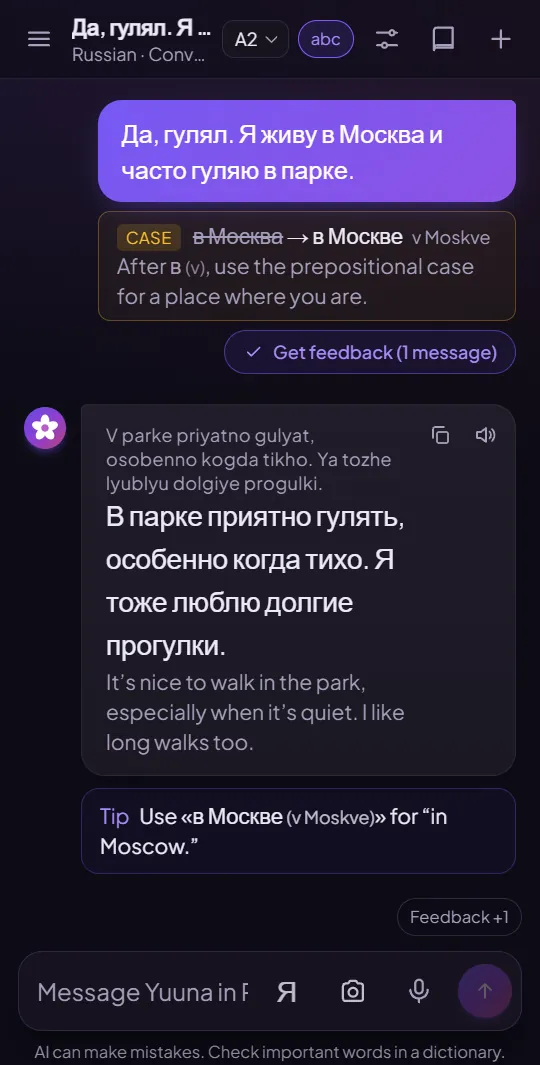
Reading Russian: Cyrillic with a romanization
Above each line the tutor writes, you see the same line in Latin letters: Привет is shown as "Privet". One switch in the chat header or in Settings hides it once you read Cyrillic.
The romanization is made by the app itself, not written by the AI model. It follows the spelling, so it does not show where the stress falls or how an unstressed о sounds; the third lesson of the starter course is about that.
Under each line is its meaning in your own language. Tap any word for a quick explanation, with links to Wiktionary and WordReference and a button to save it for review.
No Russian keyboard yet? Write Russian in Latin letters, like "ya zhivu v Moskve". The tutor reads it as Russian, writes your line back in Cyrillic and corrects only real grammar or word mistakes, never the letters.
The tutor says ты unless the scene calls for вы.
What the tutor corrects in Russian
When you make a mistake, a card shows what you wrote, the fix with its romanization, and one short reason. In Russian chats these are the usual ones:
- Case
- the ending a noun takes for its job in the sentence: в Москве, из Москвы, с другом.
- Aspect
- the two verbs for one action, ongoing or finished: читать and прочитать.
- Gender
- он, она or оно, and the past tense that follows it: я гулял, я гуляла.
- Agreement
- adjectives that must match the noun: маленькое кафе, маленькие кафе.
- Verbs of motion
- идти or ходить, ехать or ездить: going once, or going regularly.
- Word choice
- a word that exists but does not fit what you meant.
Levels: from zero to C2
You pick a level and the tutor keeps its Russian there, on the European scale from A1 to C2:
| Level in Yuuna |
|---|
| New to it (no Russian yet) |
| A1 · beginner |
| A2 · elementary |
| B1 · intermediate |
| B2 · upper intermediate |
| C1 · advanced |
| C2 · mastery |
The levels describe how hard the Russian is. They are not an exam score, and Yuuna is not a TORFL course. Not sure where you are? A short chat of about five questions finds your level.
Starting Russian from zero
Choose "New to it" and the tutor explains everything in your own language and starts with the alphabet. The starter course is 11 short lessons of 10 to 20 minutes; each one is a chat in which the tutor teaches a few things and you try them. The first four are on the writing; then come listening and speaking, the first grammar and how to recognize Russian by sight and by ear, and only then the first expressions:
- 1.The writing: first letters: the Cyrillic letters that look and sound familiar (А К М О Т) and the ones that look familiar but sound different (В Е Н Р С У Х), with tiny words.
- 2.The writing: more letters: the new letters, a few at a time (Б Г Д Ё Ж З И Й Л П Ф Ц Ч Ш Щ Э Ю Я), each with one common word.
- 3.The writing: reading words: Ы, Ь and Ъ, where the stress falls and how unstressed о sounds; hard and soft (на, ня: я ю е ё и soften the consonant before them); a final б в г д ж з said as п ф к т ш с (хлеб), then reading everyday words and names.
- 4.The writing: reading practice: reading practice with all the letters, no new ones: short words read aloud and matched both ways, the look-alikes side by side (В B, Р P, Н H, С C, У Y), and the ones the learner found hard.
- 5.Listening and speaking: hearing Russian words and telling them apart (ы and и, hard and soft consonants, where the stress falls), writing what you heard, then saying it into the microphone.
- 6.Grammar: how a sentence works: how a Russian sentence works: no word for am, is, a or the (Я студент, Это дом), не for not, and a yes/no question asked with the voice alone.
- 7.Grammar: small words and endings: the first endings: every noun is a he, she or it word, told by its last letter (дом, мама, окно), он, она, оно for things, and my as мой, моя, моё.
- 8.Recognizing it by sight and by ear: recognizing Russian by sight and by ear: the letters, words and endings that give it away, the languages it is mixed up with and the quickest tell, words you already know, where it is spoken.
- 9.Hello, thank you, goodbye
- 10.Saying who you are
- 11.Your first conversation
Things to try in Russian
Past the first lessons you choose what each chat is for: a free conversation, a role-play in which the tutor plays the other person, a short lesson, a text to read at your level, or your own writing corrected. A few of the ideas the app offers:
- Ordering at a café
- Meeting a new neighbour
- Asking for directions
- Verb endings
- A day in the city
What Yuuna does not do
- It does not score your pronunciation. You can speak instead of typing and listen to a reply, but nothing grades how you sound.
- It is not a TORFL course: there are no mock exams and no scores.
- It does not mark the stress on words.
- There is no human teacher. Every reply comes from an AI model and can be wrong.
Sign in with Google. Your first 30 messages are free.
Everything Yuuna does · All languages: Chinese · Japanese · Spanish · English · Korean · French · German · Italian · Portuguese · Arabic