 Yuuna
Practice English by talking with an AI tutor
Yuuna is an AI tutor you chat with in English. It answers at your level, corrects your mistakes and explains them in your own language, so a beginner is never left with an explanation in English that they cannot read yet.
Start practicingSign in with Google. Your first 30 messages are free.
What an English chat looks like
Yuuna
Hi!
¡Hola!
I took a long walk today and stopped at a small café.
Hoy di un largo paseo y paré en una cafetería pequeña.
The quiet break was nice.
Fue agradable descansar un rato en silencio.
Learner
I like small cafés too. Yesterday I went to cinema with my friend.
Correction · Articles
went to cinema → went to the cinema
En inglés estadounidense normalmente se dice “the cinema”; también es común “the movies”.
Yuuna
That sounds like a fun evening. What movie did you see?
Suena como una noche divertida. ¿Qué película viste?
Suggested replies
We saw a comedy.
Vimos una comedia.
I liked the movie a lot.
Me gustó mucho la película.
It was okay, but a little long.
Estuvo bien, pero fue un poco larga.
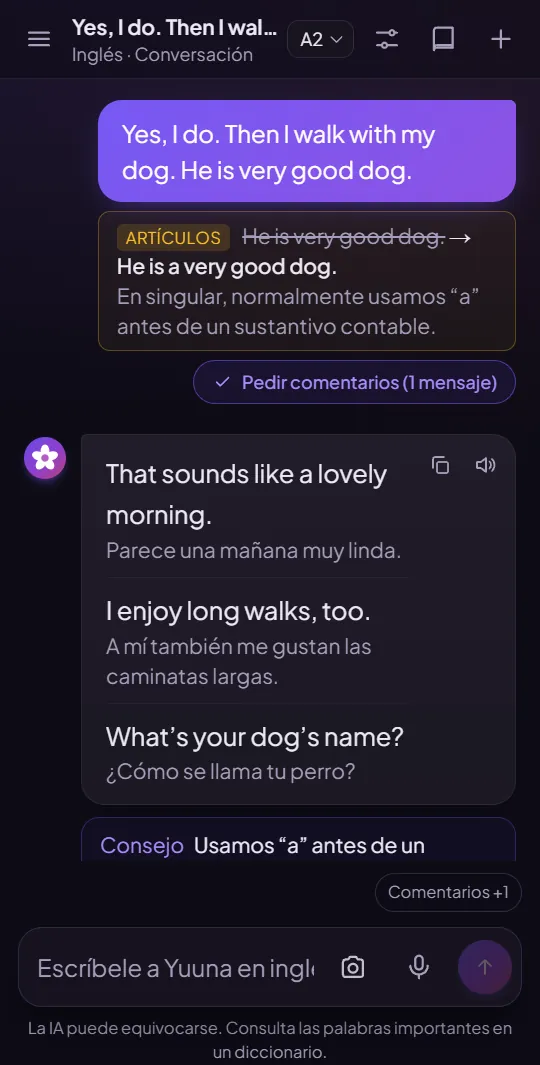
Explained in your language, American or British
The app, the explanations and the meanings come in Spanish, French, German, Italian, Portuguese, Russian, Japanese, Korean, Chinese or Arabic. In the exchange above the learner’s language is Spanish.
English has no reading line. Under each line the tutor writes is its meaning in your language. Tap any word for a quick explanation, with links to Wiktionary and the Cambridge dictionary and a button to save it for review.
English spelling does not show the sound, so listen to a reply to hear it. The first lesson of the starter course is on the letters that are said differently from what a newcomer expects.
When you are ready, you can have meanings and corrections explained in easy English instead of your own language (best from level B1).
When you start a chat you choose American English (en-US) or British English (en-GB), each with its own spelling and usage.
What the tutor corrects in English
When you make a mistake, a card shows what you wrote, the fix, and one short reason in your language. In English chats these are the usual ones:
- Articles
- a, an, the or nothing: I went to the cinema, I like music.
- Verb tense
- I went or I have gone, I work or I am working.
- Prepositions
- in, on or at, and the one a verb takes: listen to, depend on.
- Agreement
- he works, they work; this book, these books.
- Verb form
- I agree, not I am agree; she can swim, not she can swims.
- Word order
- questions with do, and where always and never go.
- Word choice
- a word that exists but does not fit what you meant.
The tutor leaves casual English alone when it is natural.
Levels: from zero to C2
You pick a level and the tutor keeps its English there, on the European scale from A1 to C2:
| Level in Yuuna |
|---|
| New to it (no English yet) |
| A1 · beginner |
| A2 · elementary |
| B1 · intermediate |
| B2 · upper intermediate |
| C1 · advanced |
| C2 · mastery |
The levels describe how hard the English is. They are not an exam score, and Yuuna is not an IELTS or TOEFL course. Not sure where you are? A short chat of about five questions finds your level.
Starting English from zero
Choose "New to it" and the tutor explains everything in your own language. The starter course is 9 short lessons of 10 to 15 minutes; each one is a chat in which the tutor teaches a few things and you try them. The first two are on how English sounds and is spelled; then come listening and speaking, the first grammar and how to recognize English by sight and by ear, and only then the first expressions:
- 1.Sounds and spelling: how English sounds and is spelled: each vowel letter short and long (cat, name), the silent e (cap, cape), th sh ch ng ee oo, w and r, and words not spelled as they sound (the, you, one).
- 2.Sounds: pronunciation practice: practice of how English sounds and is spelled, no new rules: short words read aloud and spelled from their sound, close sounds side by side (ship sheep, th s), stress, and the sounds the learner found hard.
- 3.Listening and speaking: hearing English words and telling close sounds apart (ship and sheep, th and s, and the pairs your language mixes up), writing a short word you hear, and saying words aloud with the microphone.
- 4.Grammar: how a sentence works: how an English sentence works: subject, then verb, then the rest (I am Ana, this is tea), saying not (I'm not, it isn't), and a yes/no question with the verb first (Are you OK?).
- 5.Grammar: small words and endings: a, an and the (English nouns have no gender), the plural -s, and the one everyday verb ending: -s after he, she and it (I live, she lives).
- 6.Recognizing it by sight and by ear: how to recognize English by sight and by ear: almost no accent marks, the, th and -ing everywhere, the th sound and soft r, telling it from Dutch and German, words you know, where it is spoken.
- 7.Hello, thank you, goodbye
- 8.Saying who you are
- 9.Your first conversation
Things to try in English
Past the first lessons you choose what each chat is for: a free conversation, a role-play in which the tutor plays the other person, a short lesson, a text to read at your level, or your own writing corrected. A few of the ideas the app offers:
- A job interview
- Ordering at a café
- Planning a trip
- Prepositions
- Idioms
What Yuuna does not do
- It does not score your pronunciation. You can speak instead of typing and listen to a reply, but nothing grades how you sound.
- It is not an IELTS or TOEFL course: there are no mock exams and no scores.
- There is no human teacher. Every reply comes from an AI model and can be wrong.
Sign in with Google. Your first 30 messages are free.
Everything Yuuna does · All languages: Chinese · Japanese · Spanish · Korean · French · German · Italian · Portuguese · Russian · Arabic