 Yuuna
Practice Portuguese by talking with an AI tutor
Yuuna is an AI tutor you chat with in Portuguese. It answers at your level, corrects your mistakes with a short reason in your own language, and adds the meaning of each line, in the Portuguese of Brazil or of Portugal.
Start practicingSign in with Google. Your first 30 messages are free.
What a Portuguese chat looks like
Yuuna
Oi!
Hi!
Boa noite.
Good evening.
Eu gosto da noite porque tudo fica mais calmo.
I like nighttime because everything gets calmer.
Você costuma ficar acordado até tarde?
Do you usually stay up late?
Learner
Sim, às vezes. À noite eu gosto de ouvir música em o meu quarto.
Correction · Prepositions
em o meu quarto → no meu quarto
In Portuguese, “em” combines with “o” to make “no.”
Yuuna
Também gosto de ouvir música à noite.
I also like listening to music at night.
Acho relaxante!
I find it relaxing!
Que tipo de música você gosta de ouvir?
What kind of music do you like to listen to?
Suggested replies
Gosto de música pop.
I like pop music.
Gosto de ouvir rock no meu quarto.
I like listening to rock in my room.
Prefiro música calma.
I prefer calm music.
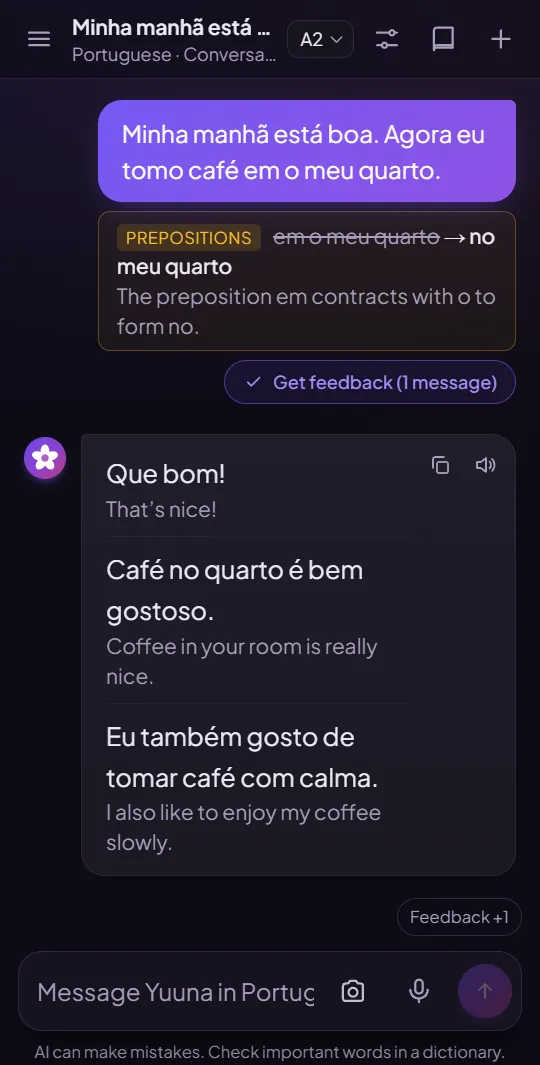
Brazil or Portugal, with the meaning under every line
Portuguese has no reading line in Yuuna: under each line the tutor writes is its meaning in your own language. Tap any word for a quick explanation, with links to Wiktionary and WordReference and a button to save it for review.
To hear how a line is said, listen to the reply. The first lesson of the starter course is on the sounds that the spelling does not show.
You can speak your answer instead of typing it.
When you start a chat you choose Brazilian Portuguese (pt-BR), where the tutor says você, or European Portuguese (pt-PT), where it says tu. The exchange above is Brazilian.
What the tutor corrects in Portuguese
When you make a mistake, a card shows what you wrote, the fix, and one short reason. In Portuguese chats these are the usual ones:
- Gender
- o or a, um or uma: o problema, a viagem.
- Agreement
- articles and adjectives that must match the noun: as casas brancas.
- Ser and estar
- the two verbs for "to be": sou alto, but estou cansado.
- Verb tense
- the two past tenses (fui, ia) and the irregular forms.
- Prepositions
- em, de, a and por, and their contractions with the article: no, na, do, da, ao, pelo.
- Word choice
- a word that exists but does not fit what you meant.
Levels: from zero to C2
You pick a level and the tutor keeps its Portuguese there, on the European scale from A1 to C2:
| Level in Yuuna |
|---|
| New to it (no Portuguese yet) |
| A1 · beginner |
| A2 · elementary |
| B1 · intermediate |
| B2 · upper intermediate |
| C1 · advanced |
| C2 · mastery |
The levels describe how hard the Portuguese is. They are not an exam score, and Yuuna is not a Celpe-Bras or CAPLE course. Not sure where you are? A short chat of about five questions finds your level.
Starting Portuguese from zero
Choose "New to it" and the tutor explains everything in your own language. The starter course is 9 short lessons of 10 to 15 minutes; each one is a chat in which the tutor teaches a few things and you try them. The first two are on how Portuguese sounds and is spelled; then come listening and speaking, the first grammar and how to recognize Portuguese by sight and by ear, and only then the first expressions:
- 1.Sounds and spelling: how Portuguese sounds and is spelled: the vowels and their marks (open é ó, closed ê ô, nasal ã õ), a vowel before m or n (bem), then ç, ch, x, j and soft g, lh, nh, r and rr, s, h, and final o and e.
- 2.Sounds: pronunciation practice: practice of how Portuguese sounds and is spelled, no new rules: short words read aloud and spelled from their sound, open and closed vowels, nasal and plain, s and z side by side, and the sounds the learner found hard.
- 3.Listening and speaking: Hearing Portuguese words played and telling close ones apart (avó, avô; lá, lã), writing short words heard, and saying words aloud with the microphone: nasal vowels, r and rr, lh and nh.
- 4.Grammar: how a sentence works: How a Portuguese sentence works: the word order, sou and é (am, is), não before the verb for not, and a yes or no question by rising voice, often answered by repeating the verb.
- 5.Grammar: small words and endings: The first building blocks: o and a, um and uma, masculine and feminine nouns (o livro, a casa), plurals with s, joined words like do and na, and the verb ending that says who (falo, fala).
- 6.Recognizing it by sight and by ear: Recognizing Portuguese by sight and by ear: ã, õ, ç and -ção, lh and nh, the nasal and sh sounds, how it differs from Spanish, words already known, and where it is spoken.
- 7.Hello, thank you, goodbye
- 8.Saying who you are
- 9.Your first conversation
Things to try in Portuguese
Past the first lessons you choose what each chat is for: a free conversation, a role-play in which the tutor plays the other person, a short lesson, a text to read at your level, or your own writing corrected. A few of the ideas the app offers:
- Ordering at a café
- Travel
- My weekend
- Prepositions
- Everyday expressions
What Yuuna does not do
- It does not score your pronunciation. You can speak instead of typing and listen to a reply, but nothing grades how you sound.
- It is not a Celpe-Bras or CAPLE course: there are no mock exams and no scores.
- There is no human teacher. Every reply comes from an AI model and can be wrong.
Sign in with Google. Your first 30 messages are free.
Everything Yuuna does · All languages: Chinese · Japanese · Spanish · English · Korean · French · German · Italian · Russian · Arabic