 Yuuna
Practice French by talking with an AI tutor
Yuuna is an AI tutor you chat with in French. It answers at your level, corrects your mistakes with a short reason in your own language, and adds the meaning of each line, so you can talk before your grammar is perfect.
Start practicingSign in with Google. Your first 30 messages are free.
What a French chat looks like
Yuuna
Salut !
Hi!
C’est déjà la nuit chez toi.
It’s already nighttime where you are.
J’aime les soirées calmes, surtout avec un vieux film.
I like quiet evenings, especially with an old movie.
Tu regardes parfois des films le soir ?
Do you sometimes watch movies in the evening?
Learner
Oui, souvent. Hier soir, j'ai allé au cinéma avec une amie.
Correction · Verb tense
j'ai allé → je suis allé(e)
“Aller” uses “être” in the passé composé.
Yuuna
Ah, une sortie au cinéma, c’est toujours sympa ! Vous avez vu quel film ?
Ah, going to the movies is always nice! What movie did you see?
TipWith “être,” the past participle agrees with the speaker: “allé” for a man, “allée” for a woman.
Suggested replies
On a vu une comédie.
We saw a comedy.
Le film était très drôle.
The movie was very funny.
Je ne me souviens plus du titre.
I don’t remember the title anymore.
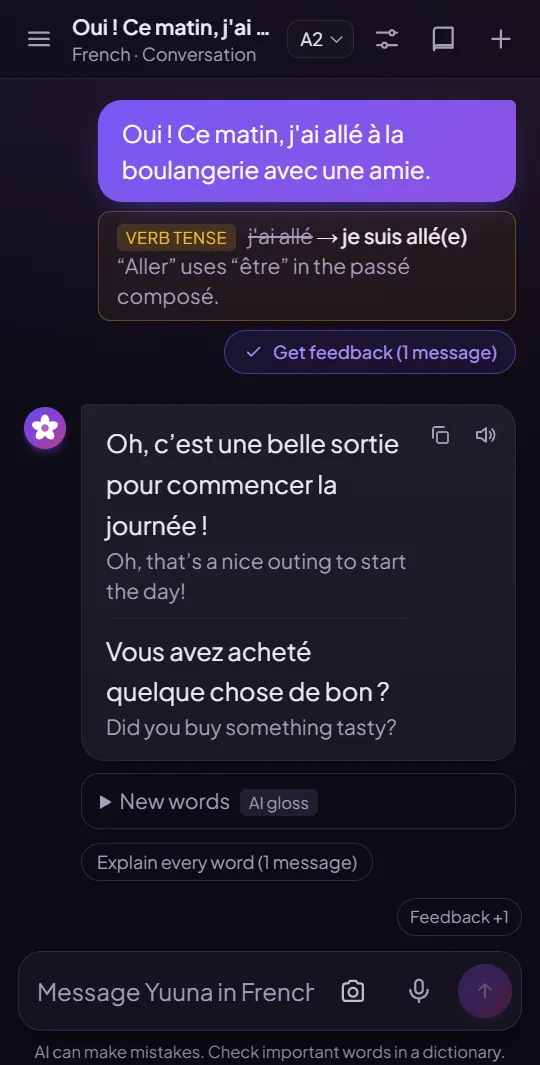
France or Quebec, with the meaning under every line
French has no reading line in Yuuna: under each line the tutor writes is its meaning in your own language. Tap any word for a quick explanation, with links to Wiktionary and WordReference and a button to save it for review.
To hear how a line is said, listen to the reply: French spelling and sound are far apart, and the first lesson of the starter course is about exactly that.
The tutor says tu unless the scene calls for vous.
Now and then a reply ends with a short tip, like the one on allé and allée in the exchange above.
When you start a chat you choose the French of France (fr-FR) or of Canada (fr-CA).
What the tutor corrects in French
When you make a mistake, a card shows what you wrote, the fix, and one short reason. In French chats these are the usual ones:
- Gender
- le or la, un or une: le problème, la voiture.
- Agreement
- adjectives and past participles that must match: elles sont allées.
- Verb tense
- passé composé or imparfait, and être or avoir as the helping verb.
- Subjunctive
- after il faut que or je veux que: il faut que tu viennes.
- Prepositions
- à or de, en or dans, and au, aux, du, des.
- Word choice
- a word that exists but does not fit what you meant.
Levels: from zero to C2
You pick a level and the tutor keeps its French there, on the European scale from A1 to C2:
| Level in Yuuna |
|---|
| New to it (no French yet) |
| A1 · beginner |
| A2 · elementary |
| B1 · intermediate |
| B2 · upper intermediate |
| C1 · advanced |
| C2 · mastery |
The levels describe how hard the French is. They are not an exam score, and Yuuna is not a DELF course. Not sure where you are? A short chat of about five questions finds your level.
Starting French from zero
Choose "New to it" and the tutor explains everything in your own language. The starter course is 9 short lessons of 10 to 15 minutes; each one is a chat in which the tutor teaches a few things and you try them. The first two are on how French sounds and is spelled; then come listening and speaking, the first grammar and how to recognize French by sight and by ear, and only then the first expressions:
- 1.Sounds and spelling: how French sounds and is spelled: the vowels, then the letters said differently: e é è ê, u, ou oi au eau ai, ç, j and soft g, ch, the r, h, nasal an on in, silent endings, apostrophes (l'eau).
- 2.Sounds: pronunciation practice: practice of how French sounds and is spelled, no new rules: short words read aloud and spelled from their sound, look-alikes side by side (u ou, é è, an on in), and the sounds the learner found hard.
- 3.Listening and speaking: hearing French words and telling close sounds apart (tu and tout, the nasal vowels, le and les), writing a short word you hear, and saying words aloud with the microphone.
- 4.Grammar: how a sentence works: how a French sentence works: subject then verb (je suis, c'est), saying not with ne ... pas around the verb, and a yes/no question by raising your voice or with est-ce que.
- 5.Grammar: small words and endings: every noun is masculine or feminine (un, une, le, la, l', les), the plural s you write but do not hear, and one verb whose spelling changes but not its sound (je parle, tu parles).
- 6.Recognizing it by sight and by ear: how to recognize French by sight and by ear: accents, apostrophes, eau and oi, nasal vowels and the throaty r, telling it from Spanish, Italian and Portuguese, words you know, where it is spoken.
- 7.Hello, thank you, goodbye
- 8.Saying who you are
- 9.Your first conversation
Things to try in French
Past the first lessons you choose what each chat is for: a free conversation, a role-play in which the tutor plays the other person, a short lesson, a text to read at your level, or your own writing corrected. A few of the ideas the app offers:
- Ordering at a café
- Checking into a hotel
- Past tense
- Articles and gender
- Everyday expressions
What Yuuna does not do
- It does not score your pronunciation. You can speak instead of typing and listen to a reply, but nothing grades how you sound.
- It is not a DELF or DALF course: there are no mock exams and no scores.
- There is no human teacher. Every reply comes from an AI model and can be wrong.
Sign in with Google. Your first 30 messages are free.
Everything Yuuna does · All languages: Chinese · Japanese · Spanish · English · Korean · German · Italian · Portuguese · Russian · Arabic