 Yuuna
Practice Arabic by talking with an AI tutor
Yuuna is an AI tutor you chat with in Modern Standard Arabic, the written language of news and books. It answers at your level, corrects your mistakes with a short reason in your own language, and gives the meaning of each line.
Start practicingSign in with Google. Your first 30 messages are free.
What an Arabic chat looks like
Yuuna
مرحبًا!
Hello!
مشيتُ قليلًا اليوم، ثم جلستُ في مقهى صغير.
I walked a little today, then sat in a small café.
أحب الهدوء هناك.
I like the quiet there.
هل تحب المقاهي؟
Do you like cafés?
Learner
نعم، أحب المقاهي. أسكن في مدينة كبير وفيها مقاهٍ كثيرة.
Correction · Agreement
مدينة كبير ← مدينة كبيرة
The adjective must be feminine to agree with مدينة.
Yuuna
يبدو أن فيها أماكن كثيرة جميلة.
It sounds like it has many nice places.
أحب زيارة مقهى جديد من وقت إلى آخر.
I like visiting a new café from time to time.
هل لديك مقهى تحبه؟
Do you have a café you like?
Tipمدينة is feminine, so its adjective also takes the feminine form: كبيرة.
Suggested replies
نعم، أحب مقهى قريبًا من بيتي.
Yes, I like a café near my home.
أحب المقاهي الهادئة.
I like quiet cafés.
لا أعرف اسم المقهى.
I don’t know the café’s name.
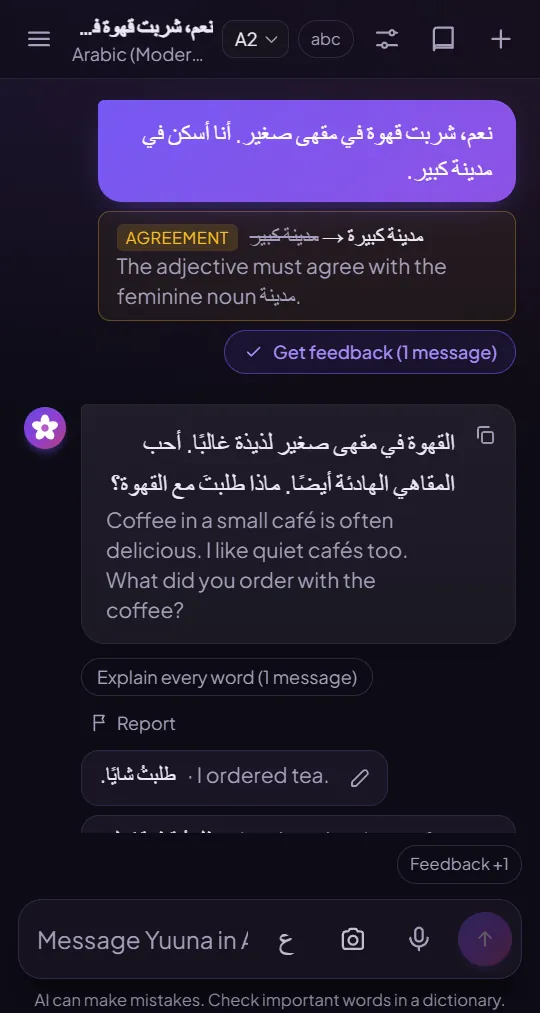
Reading Arabic: vowel marks and an optional romanization
Arabic chats are laid out right to left. At the beginner levels the tutor adds short vowel marks to words a beginner may misread, as in مشيتُ and قليلًا in the exchange above.
A romanization of each line is off at first; switch it on in the chat header or in Settings if you want it. It is written by the AI model, so now and then it is wrong.
Under each line is its meaning in your own language. Tap any word for a quick explanation, with links to Wiktionary and the Almaany dictionary and a button to save it for review.
No Arabic keyboard yet? Write Arabic in Latin letters, like "ana uhibbu al-qahwa". The tutor reads it as Arabic, writes your line back in Arabic script and corrects only real grammar or word mistakes, never the letters.
What the tutor corrects in Arabic
When you make a mistake, a card shows what you wrote, the fix, and one short reason. In Arabic chats these are the usual ones:
- Gender
- masculine or feminine nouns, and the verb form that goes with each.
- Agreement
- an adjective that must match its noun: مدينة كبيرة, بيت كبير.
- Verb form
- the ending for who does it, and past or present: كتبتُ, أكتبُ.
- Definiteness
- when ال is needed on the noun, the adjective or both: البيت الكبير.
- Word order
- the adjective after the noun, and the verb before or after its subject.
- Prepositions
- في, إلى, من and على with the right verb.
- Spelling
- hamza, ة or ه, and ى or ي at the end of a word.
- Word choice
- a word that exists but does not fit what you meant.
Levels: from zero to C2
You pick a level and the tutor keeps its Arabic there, on the European scale from A1 to C2:
| Level in Yuuna |
|---|
| New to it (no Arabic yet) |
| A1 · beginner |
| A2 · elementary |
| B1 · intermediate |
| B2 · upper intermediate |
| C1 · advanced |
| C2 · mastery |
The levels describe how hard the Arabic is. They are not an exam score. Not sure where you are? A short chat of about five questions finds your level.
Starting Arabic from zero
Choose "New to it" and the tutor explains everything in your own language and starts with the letters. The starter course is 11 short lessons of 10 to 20 minutes; each one is a chat in which the tutor teaches a few things and you try them. The first four are on the writing; then come listening and speaking, the first grammar and how to recognize Arabic by sight and by ear, and only then the first expressions:
- 1.The writing: first letters: how Arabic is written (right to left, letters join, short vowels are usually not written), the first letters ا ب ت ث ن ي, the three short vowel marks and sukun.
- 2.The writing: more letters: more letters in their look-alike groups (ج ح خ, د ذ, ر ز, س ش, ص ض, ط ظ), how each joins, with one short word per group, then shadda, the doubling mark.
- 3.The writing: reading words: the remaining letters (ع غ ف ق ك ل م ه و) and long vowels, then the special shapes and marks: لا, ة and ى at the end of a word, the hamza (أ إ آ ء) and tanwin, in short words.
- 4.The writing: reading practice: reading practice with all the letters, no new ones: short words read aloud and matched both ways, look-alikes side by side (ب ت ث ن ي, ج ح خ, د ذ, ر ز, س ش, ص ض, ط ظ, ع غ, ف ق), joined shapes, shadda, tanwin and hamza, and the ones the learner found hard.
- 5.Listening and speaking: hearing Arabic words and telling them apart (the throat sounds, deep ق, heavy letters and their plain partners, long and doubled sounds), writing what you heard, then saying it aloud.
- 6.Grammar: how a sentence works: how an Arabic sentence works: no word for is (أنا طالب, هذا بيت), the describing word after the noun, لا for no and, before a verb, for not, and هل to start a yes/no question.
- 7.Grammar: small words and endings: the first small words and endings: ال for the and how it sounds before sun letters, ة for feminine words (طالب, طالبة), and ي for my (اسمي).
- 8.Recognizing it by sight and by ear: recognizing Arabic by sight and by ear: what gives it away, the languages it is mixed up with (Persian, Urdu, Hebrew) and the quickest tell, words you already know, where it is spoken.
- 9.Hello, thank you, goodbye
- 10.Saying who you are
- 11.Your first conversation
Things to try in Arabic
Past the first lessons you choose what each chat is for: a free conversation, a role-play in which the tutor plays the other person, a short lesson, a text to read at your level, or your own writing corrected. A few of the ideas the app offers:
- Ordering at a café
- Meeting a new neighbour
- Numbers and time
- Asking for directions
- Everyday expressions
What Yuuna does not do
- It does not score your pronunciation. You can speak instead of typing and listen to a reply, but nothing grades how you sound.
- It is not a course in a spoken dialect: the levels and the starter course are for Modern Standard Arabic.
- It does not teach handwriting. You can send a photo of your handwriting and ask about it.
- There is no human teacher. Every reply comes from an AI model and can be wrong, including the romanization.
Sign in with Google. Your first 30 messages are free.
Everything Yuuna does · All languages: Chinese · Japanese · Spanish · English · Korean · French · German · Italian · Portuguese · Russian