 Yuuna
Practice Japanese by talking with an AI tutor
Yuuna is an AI tutor you chat with in Japanese. It answers at your level, corrects your mistakes with a short reason in your own language, and shows how every line is read, so you can start before you know a single kanji.
Start practicingSign in with Google. Your first 30 messages are free.
What a Japanese chat looks like
Yuuna
こんにちは。 きょうは ちいさな かふぇまで あるきました。
konnichiwa. kyou wa chiisana kafe made arukimashita.
こんにちは。今日は小さなカフェまで歩きました。
Hi. Today I walked to a small café.
しずかで、いい きぶんでした。 かふぇに よく いきますか。
shizukade, ii kibun deshita. kafe ni yoku ikimasu ka.
静かで、いい気分でした。カフェによく行きますか。
It was quiet, and I felt good. Do you often go to cafés?
Learner
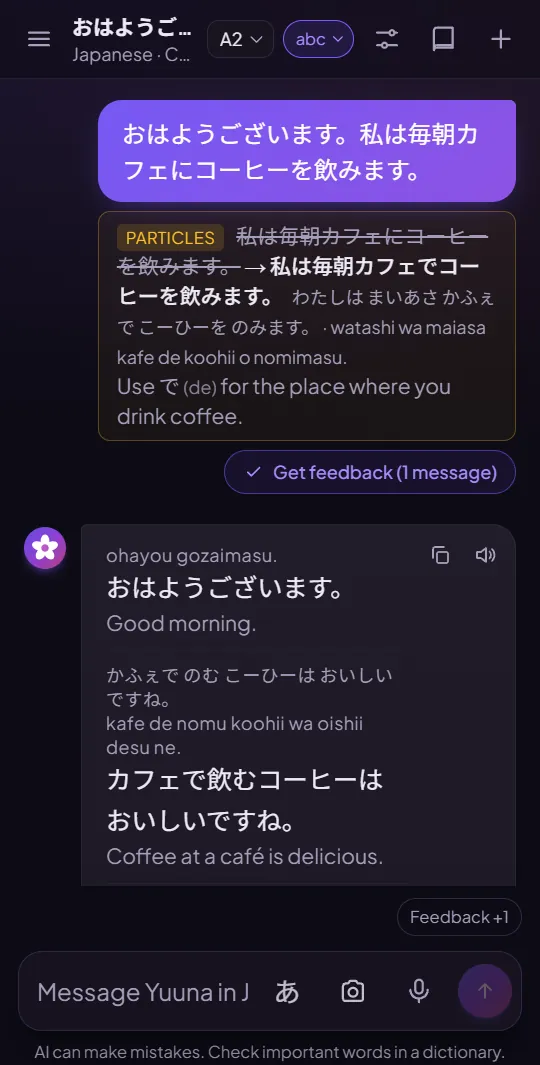
はい、よく行きます。カフェにコーヒーを飲みます。
Correction · Particles
カフェにコーヒーを飲みます。 → カフェでコーヒーを飲みます。
かふぇで こーひーを のみます。 · kafe de koohii o nomimasu.
Use で (de) for the place where you do an action.
Yuuna
わたしも かふぇで こーひーを のむのが すきです。 ゆっくり できて いいですね。
watashi mo kafe de koohii o nomunoga suki desu. yukkuri dekite ii desu ne.
私もカフェでコーヒーを飲むのが好きです。ゆっくりできていいですね。
I also like drinking coffee at cafés. It’s nice to relax there.
Suggested replies
どんな こーひーが すきですか。
donna koohii ga suki desu ka.
どんなコーヒーが好きですか。
What kind of coffee do you like?
わたしは かふぇらてが すきです。
watashi wa kaferate ga suki desu.
私はカフェラテが好きです。
I like café lattes.
しずかな かふぇが すきです。
shizukana kafe ga suki desu.
静かなカフェが好きです。
I like quiet cafés.
Reading Japanese: kana and romaji
Above each line the tutor writes, you see the same line in hiragana with a space after each word, and in romaji. Keep both, only kana, only romaji or neither: the switch is in the chat header and in Settings.
Under each line is its meaning in your own language. Tap any word for a quick explanation, with links to Wiktionary and Jisho and a button to save it for review.
Cannot type Japanese yet? Write it in Latin letters, like "kafe de koohii o nomimasu". The tutor reads it as Japanese, writes your line back in Japanese and corrects only real grammar or word mistakes, never the letters.
At the beginner levels the tutor writes words that beginners rarely know in kanji in kana, and keeps kanji for very common words.
The kana and romaji are written by the AI model, so now and then a reading is wrong. Check a word that matters in a dictionary.
What the tutor corrects in Japanese
When you make a mistake, a card shows your line, the fixed line with its reading, and one short reason. In Japanese chats these are the usual ones:
- Particles
- は or が, に or で, を: the small words that say who does what, where and to what.
- Politeness level
- mixing polite です/ます forms with casual ones in the same conversation.
- Verb forms
- the ます form, the て form, past and negative endings.
- Word choice
- a word that exists but does not fit what you meant.
- Counters
- the counting words Japanese puts after numbers, such as 一つ, 一人 and 一本.
- Word order
- where the verb, the time and the place go in the sentence.
The tutor speaks polite Japanese (です/ます) unless the scene is a casual one between friends. You can also set the tone of each chat yourself.
Levels: from zero to JLPT N1
You pick a level and the tutor keeps its Japanese there. Yuuna uses the European A1 to C2 scale and shows the nearest JLPT level next to it:
| Level in Yuuna | About the same as |
|---|---|
| New to it (no Japanese yet) | before the first level |
| A1 · beginner | JLPT N5 |
| A2 · elementary | JLPT N4 |
| B1 · intermediate | JLPT N3 |
| B2 · upper intermediate | JLPT N2 |
| C1 · advanced | JLPT N1 |
| C2 · mastery | JLPT N1+ |
The JLPT names are a rough guide to how hard the Japanese is. They are not an exam score, and Yuuna is not a JLPT course. Not sure where you are? A short chat of about five questions finds your level.
Starting Japanese from zero
Choose "New to it" and the tutor explains everything in your own language and starts with hiragana. The starter course is 13 short lessons of 10 to 20 minutes; each one is a chat in which the tutor teaches a few things and you try them. The first six are on the writing (hiragana, katakana and the first kanji); then come listening and speaking, the first grammar and how to recognize Japanese by sight and by ear, and only then the first expressions:
- 1.The writing: first letters: how Japanese sounds, then the first ten hiragana: あ い う え お and か き く け こ, with two or three tiny words made only from them.
- 2.The writing: more letters: the rest of hiragana, a row or two at a time (さ to わ, ん), each row with one or two common words; を (read o) with the わ row; revise earlier rows as you go.
- 3.The writing: reading words: the marks ゛ (が ざ だ ば) and ゜ (ぱ), small っ ゃ ゅ ょ and long vowels, then katakana: what it is for (foreign words and names), the bar ー, and the letters of ケーキ cake and カメラ camera, each beside its hiragana look-alike (カ か, キ き, ケ け, メ め, ラ ら).
- 4.The writing: katakana
- 5.The writing: first kanji
- 6.The writing: reading practice: reading practice with all of hiragana, katakana and the first kanji, no new letters: short words read aloud and matched both ways, look-alikes side by side (さ ち, ぬ め, ね れ わ, る ろ, シ ツ, ソ ン, 人 入), and the ones the learner found hard.
- 7.Listening and speaking: hearing Japanese and saying it: short and long vowels, single and double consonants, k or g (か が, き ぎ), the even beat of its syllables, saying words aloud with the microphone.
- 8.Grammar: how a sentence works: how a Japanese sentence works: the verb or です comes last, X は Y です (I am a student), saying not with じゃないです, and a yes/no question with か.
- 9.Grammar: small words and endings: the first small words and endings: は, を, の and も placed after a word, the verb ending ます and its not form ません, and nouns with no articles, plural or gender.
- 10.Recognizing it by sight and by ear: recognizing Japanese: three scripts mixed (kanji, round hiragana, angular katakana), vowel-ending syllables on an even beat, telling it from Chinese and Korean, known words, where it is spoken.
- 11.Hello, thank you, goodbye
- 12.Saying who you are
- 13.Your first conversation
Things to try in Japanese
Past the first lessons you choose what each chat is for: a free conversation, a role-play in which the tutor plays the other person, a short lesson, a text to read at your level, or your own writing corrected. A few of the ideas the app offers:
- Ordering at a café
- Checking into a hotel
- Asking for directions
- Polite requests
- Past tense
What Yuuna does not do
- It does not score your pronunciation. You can speak instead of typing and listen to a reply, but nothing grades how you sound.
- It is not a JLPT course: there are no mock exams and no scores.
- It does not teach stroke order. You can send a photo of your handwriting and ask about it.
- There is no human teacher. Every reply comes from an AI model and can be wrong, including the kana and romaji.
Sign in with Google. Your first 30 messages are free.
Everything Yuuna does · All languages: Chinese · Spanish · English · Korean · French · German · Italian · Portuguese · Russian · Arabic