 Yuuna
Practice German by talking with an AI tutor
Yuuna is an AI tutor you chat with in German. It answers at your level, corrects your mistakes with a short reason in your own language, and adds the meaning of each line, so the grammar gets practiced in real sentences instead of tables.
Start practicingSign in with Google. Your first 30 messages are free.
What a German chat looks like
Yuuna
Hallo!
Hi!
Am Abend ist es oft schön ruhig.
In the evening, it is often nice and quiet.
Ich sitze gern in einem kleinen Café und trinke Tee.
I like to sit in a small café and drink tea.
Was machst du heute Abend?
What are you doing tonight?
Learner
Heute Abend ich koche Pasta mit einer Freundin.
Correction · Verb position
Heute Abend ich koche Pasta mit einer Freundin. → Heute Abend koche ich Pasta mit einer Freundin.
After a time phrase at the start, the verb comes before the subject.
Yuuna
Das klingt schön!
That sounds nice!
Zusammen kochen macht Spaß.
Cooking together is fun.
Welche Soße macht ihr?
What sauce are you making?
Suggested replies
Wir machen Tomatensoße.
We’re making tomato sauce.
Wir machen Pesto.
We’re making pesto.
Ich weiß es noch nicht.
I don’t know yet.
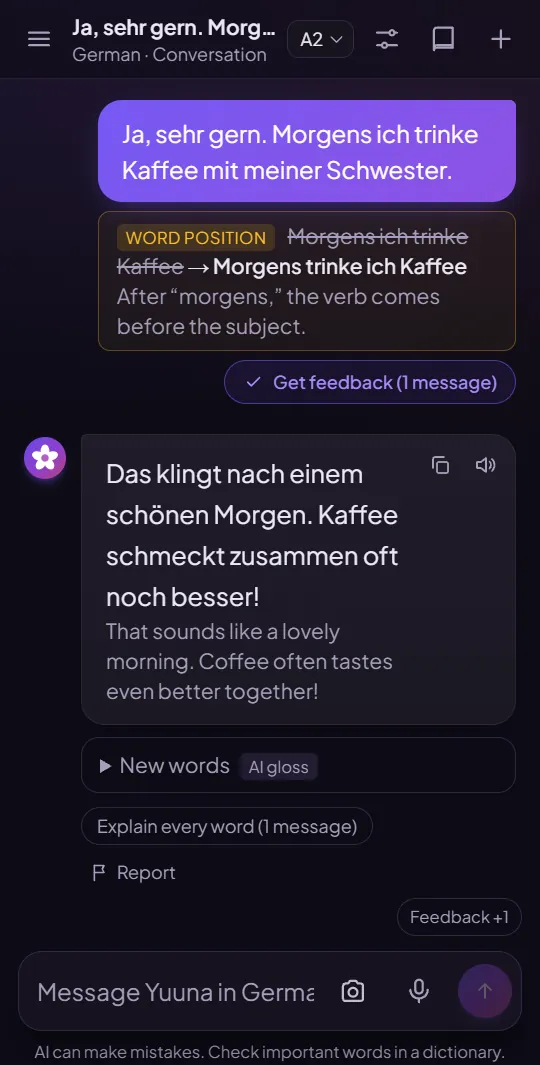
The meaning under every line
German has no reading line in Yuuna: under each line the tutor writes is its meaning in your own language. Tap any word for a quick explanation, with links to Wiktionary and WordReference and a button to save it for review.
The tutor says du unless the scene calls for Sie.
You can speak your answer instead of typing it, and listen to any reply.
What the tutor corrects in German
When you make a mistake, a card shows what you wrote, the fix, and one short reason. In German chats these are the usual ones:
- Case
- den, dem or des: mit dem Freund, für den Freund.
- Gender
- der, die or das: der Tisch, die Lampe, das Buch.
- Word order
- time before manner before place, and where nicht goes.
- Verb position
- the verb in second place, and at the end after weil or dass: Heute koche ich.
- Adjective endings
- ein kleiner Hund, einen kleinen Hund, mit einem kleinen Hund.
- Word choice
- a word that exists but does not fit what you meant.
Levels: from zero to C2
You pick a level and the tutor keeps its German there, on the European scale from A1 to C2:
| Level in Yuuna |
|---|
| New to it (no German yet) |
| A1 · beginner |
| A2 · elementary |
| B1 · intermediate |
| B2 · upper intermediate |
| C1 · advanced |
| C2 · mastery |
The levels describe how hard the German is. They are not an exam score, and Yuuna is not a Goethe or telc course. Not sure where you are? A short chat of about five questions finds your level.
Starting German from zero
Choose "New to it" and the tutor explains everything in your own language. The starter course is 9 short lessons of 10 to 15 minutes; each one is a chat in which the tutor teaches a few things and you try them. The first two are on how German sounds and is spelled; then come listening and speaking, the first grammar and how to recognize German by sight and by ear, and only then the first expressions:
- 1.Sounds and spelling: how German sounds and is spelled: the vowels, then the letters said differently: ä ö ü, ß, ei ie eu, ch sch, sp st (shp sht), w v z j s, final b d g (p t k), the r, a capital on every noun.
- 2.Sounds: pronunciation practice: practice of how German sounds and is spelled, no new rules: short words read aloud and spelled from their sound, long and short vowels, ei ie, o ö, u ü side by side, and the sounds the learner found hard.
- 3.Listening and speaking: hearing German words and telling close sounds apart (ei and ie, o and ö, u and ü, long and short vowels), writing a short word you hear, and saying words aloud with the microphone.
- 4.Grammar: how a sentence works: how a German sentence works: the verb in second place (ich bin, das ist), saying not with nicht, and a yes/no question with the verb first (Bist du müde?).
- 5.Grammar: small words and endings: der, die and das (the) and ein, eine (a), why every noun is learned with its gender, and the first verb endings (ich komme, du kommst, er kommt).
- 6.Recognizing it by sight and by ear: how to recognize German by sight and by ear: capitals on every noun, ä ö ü and ß, long words, the ch sounds and crisp endings, telling it from Dutch and Swedish, words you know, where it is spoken.
- 7.Hello, thank you, goodbye
- 8.Saying who you are
- 9.Your first conversation
Things to try in German
Past the first lessons you choose what each chat is for: a free conversation, a role-play in which the tutor plays the other person, a short lesson, a text to read at your level, or your own writing corrected. A few of the ideas the app offers:
- Ordering at a café
- A job interview
- Asking for directions
- Articles and gender
- Prepositions
What Yuuna does not do
- It does not score your pronunciation. You can speak instead of typing and listen to a reply, but nothing grades how you sound.
- It is not a Goethe or telc course: there are no mock exams and no scores.
- It has one German: there is no setting for Austrian or Swiss usage.
- There is no human teacher. Every reply comes from an AI model and can be wrong.
Sign in with Google. Your first 30 messages are free.
Everything Yuuna does · All languages: Chinese · Japanese · Spanish · English · Korean · French · Italian · Portuguese · Russian · Arabic